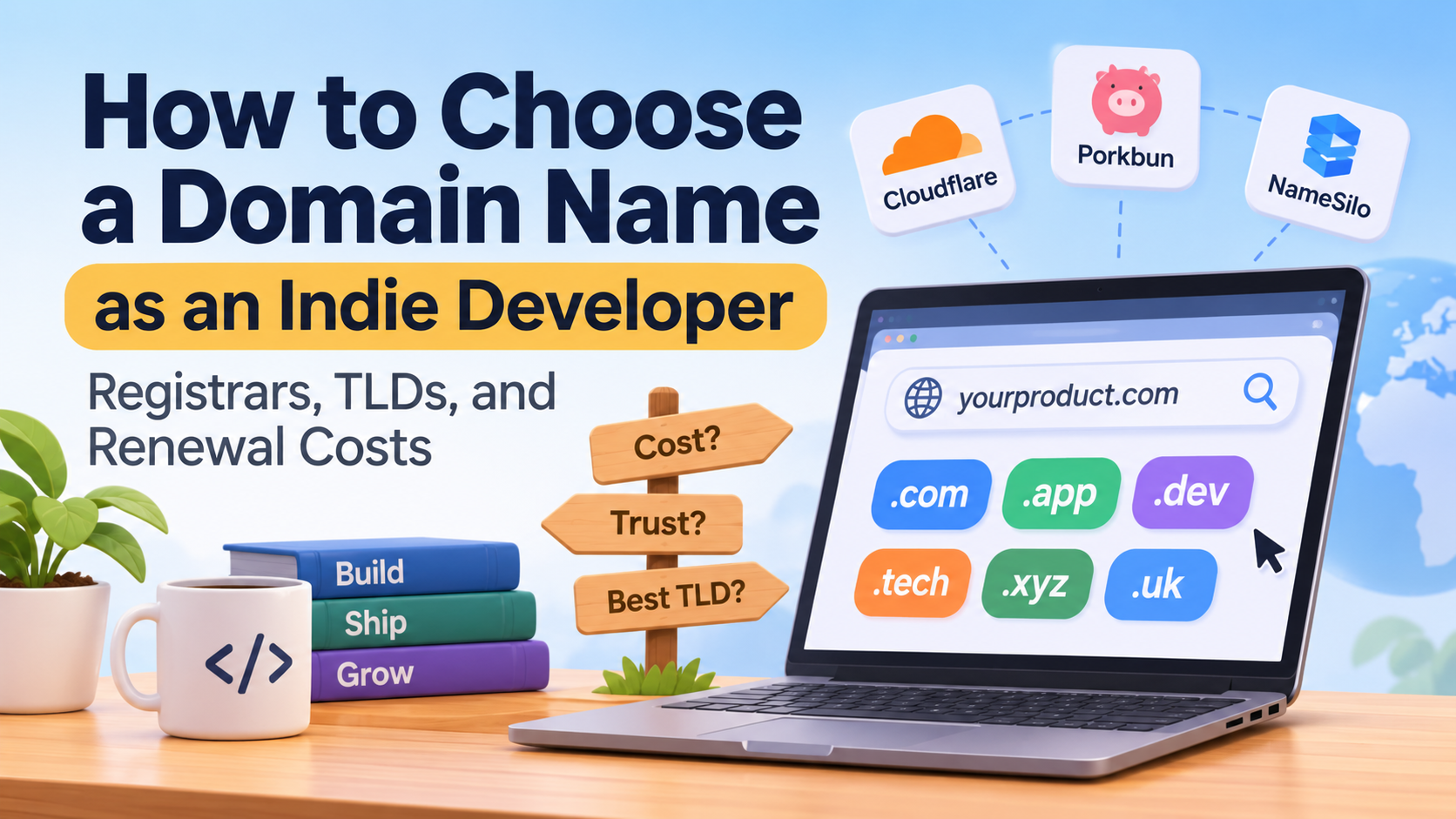
For indie developers, a domain name is more than just a website address. It is an important part of your product’s identity and brand.
Whether you are building a SaaS platform, a browser extension, an online productivity tool, or a consumer-facing web application, choosing the right domain can make your product easier to remember and help establish trust with potential users.
However, choosing a domain often raises several questions:
- Which domain registrar should you use?
- What are the differences between .com, .app, .dev, and .tech?
- Are there domain extensions with annual renewal costs below $8?
- Why are some domains extremely cheap in the first year but expensive to renew?
- Which domain extensions are best for consumer-facing indie products?
This guide explores domain registration from the perspective of long-term ownership costs, branding, and practical usage.
1. Choosing a Domain Registrar
If your product primarily targets international users and does not require a Chinese ICP filing, overseas domain registrars are worth considering.
Three popular options among developers and website owners are:
- Cloudflare Registrar
- Porkbun
- NameSilo
1.1 Cloudflare Registrar
Cloudflare Registrar uses a transparent pricing model based on registry costs, without the traditional registrar markup.
Key advantages:
- Transparent registration and renewal pricing.
- Free WHOIS privacy protection for supported extensions.
- Native integration with Cloudflare DNS.
- Easy access to CDN, SSL/TLS, and DDoS protection.
- Integration with Cloudflare Pages and Workers.
One important limitation is that domains registered through Cloudflare Registrar must use Cloudflare’s nameservers.
You cannot freely switch the domain to another DNS provider while keeping it registered with Cloudflare.
If you already use Cloudflare to manage your website, DNS, and CDN, registering your domain there can simplify your infrastructure.
Website: https://www.cloudflare.com/products/registrar/
1.2 Porkbun
Porkbun is a popular domain registrar among indie developers because of its competitive pricing and straightforward management interface.
Key advantages:
- Competitive domain registration and renewal prices.
- A wide selection of domain extensions.
- Free WHOIS privacy protection for supported extensions.
- Support for third-party nameservers.
- A modern and relatively simple dashboard.
- Additional services such as email forwarding.
Unlike Cloudflare Registrar, Porkbun does not require you to use its own DNS service.
You can register a domain through Porkbun while managing DNS through Cloudflare, Vercel, or another provider.
This flexibility makes Porkbun a good choice for developers who prefer keeping their domain registrar and DNS provider independent.
Website: https://porkbun.com/
1.3 NameSilo
NameSilo is an established domain registrar that is particularly suitable for users managing multiple domains.
Key advantages:
- Free WHOIS privacy protection for supported extensions.
- Support for third-party nameservers.
- Convenient bulk domain management.
- Relatively transparent pricing.
- Multiple payment options.
Its dashboard is not as modern as Porkbun’s, but it provides the essential features needed for domain registration, renewal, and DNS management.
Website: https://www.namesilo.com/
1.4 Which Registrar Should You Choose?
| Feature | Cloudflare | Porkbun | NameSilo |
|---|---|---|---|
| Pricing model | Registry cost | Competitive pricing | Competitive pricing |
| WHOIS privacy | Free for supported TLDs | Free for supported TLDs | Free for supported TLDs |
| Third-party nameservers | Not supported | Supported | Supported |
| DNS service | Cloudflare DNS | Flexible | Flexible |
| Bulk management | Basic | Supported | Convenient |
| Best for | Existing Cloudflare users | Indie developers | Multiple domain owners |
My recommendation:
Choose Cloudflare Registrar if you already use Cloudflare to manage your DNS, CDN, and website infrastructure.
Choose Porkbun if you want greater flexibility and prefer keeping your domain registrar independent from your DNS provider.
2. Popular Domain Extensions and Their Renewal Costs
A domain extension, also known as a Top-Level Domain (TLD), affects both the appearance of your domain and its long-term ownership cost.
Different TLD registries have significantly different pricing structures.
Here are some approximate annual renewal prices for popular extensions:
| Extension | Estimated Annual Renewal | Common Use Cases |
|---|---|---|
| .com | $10–$15 | Commercial websites and personal brands |
| .net | $12–$16 | Network services and technology websites |
| .org | $10–$15 | Communities and open-source projects |
| .dev | $12–$15 | Developers and technical tools |
| .app | $12–$20 | Software, mobile apps, and SaaS |
| .io | $35–$60 | Tech startups and SaaS products |
| .ai | $80–$100+ | AI products and services |
| .tech | $40–$60 | Technology companies and brands |
| .cc | $8–$12 | Personal projects and lightweight tools |
| .uk | $5–$8 | UK-focused websites |
| .work | $6–$10 | Productivity and work-related tools |
| .xyz | $1–$15+ | Personal projects and experimental websites |
Important: These are approximate reference prices for standard, non-premium domains. Actual prices vary by registrar, registry pricing, promotions, and applicable fees.
Some extensions also have different registration, renewal, and transfer prices.
Always check the renewal price displayed at checkout rather than relying exclusively on the advertised first-year price.
A domain that costs only a few dollars initially may become significantly more expensive in the following years.
3. Are There Domain Extensions with Annual Renewals Below $8?
Yes. There are several domain extensions worth exploring if you want to minimize long-term ownership costs.
3.1 Numeric .xyz Domains
This is a particularly interesting category.
Certain numeric .xyz domains belong to a special pricing class, such as the 1.111B Class.
Eligible numeric domains may have registration and renewal prices as low as approximately $0.99 per year.
Examples:
- 123456.xyz
- 202611.xyz
- 888888.xyz
However, there are several important details:
- Only domains meeting the registry’s specific eligibility rules qualify.
- Ordinary word-based .xyz domains do not necessarily receive this pricing.
- Standard .xyz renewal prices can be significantly higher.
For internal tools, experiments, and personal projects where branding is not a priority, this can be an extremely inexpensive option.
For a serious consumer-facing product, however, I would not make a numeric .xyz domain the first choice.
3.2 .uk and .co.uk
These are UK country-code top-level domains.
Their main advantages include:
- Relatively low annual renewal costs.
- Strong recognition in the UK market.
- Suitability for websites targeting British users.
Registration eligibility, contact requirements, and privacy protection policies may vary depending on the extension and registrar.
Check the specific registration rules before purchasing.
3.3 .work
The .work extension has an intuitive meaning and is suitable for productivity and work-related applications.
Example combinations:
- task.work
- focus.work
- daily.work
Some registrars offer annual renewal prices below $8, although actual pricing depends on the domain and registrar.
3.4 .cc
The .cc extension is short and visually simple.
Advantages include:
- Only two letters.
- Flexible domain combinations.
- A potential alternative when the .com version is unavailable.
- Relatively affordable pricing at some registrars.
At Cloudflare Registrar, some .cc domains are priced around $8 per year.
However, .cc does not have the same level of recognition or brand trust as .com among general consumers.
3.5 Which Low-Cost Extension Should You Choose?
| Use Case | Suggested Extensions |
|---|---|
| Experimental projects | .xyz |
| Internal tools | .work |
| UK-focused websites | .uk / .co.uk |
| Lightweight personal projects | .cc |
| Commercial products | Prefer .com |
One important principle:
Low renewal costs should not be the only factor when choosing a domain.
Saving $5 per year is not necessarily worthwhile if the domain is difficult to remember or makes your product appear less trustworthy.
4. What Is the Difference Between .dev and .tech?
Both extensions are associated with technology, but they have different positioning and long-term costs.
| Feature | .dev | .tech |
|---|---|---|
| Registry | Google Registry | Radix |
| Primary audience | Developers and software engineers | Technology companies and commercial products |
| HTTPS requirement | Mandatory | Not mandatory |
| Estimated renewal | $12–$15/year | $40–$60/year |
| Brand positioning | Developer-focused | Technology-focused |
4.1 .dev: Designed for Developers
.dev is a top-level domain operated by Google Registry.
Its most important technical characteristic is mandatory HTTPS.
The entire .dev TLD is included in the browser HSTS Preload List.
This means browsers automatically enforce HTTPS when accessing .dev websites.
For example:
https://example.dev
A regular HTTP connection will not work:
http://example.dev
If you use modern hosting platforms such as Cloudflare Pages or Vercel, automatic HTTPS configuration usually makes this requirement straightforward.
.dev is particularly suitable for:
- Personal developer websites.
- Technical blogs.
- API documentation.
- Open-source projects.
- Developer tools.
4.2 .tech: Designed for Technology Brands
.tech has a broader technology-oriented positioning.
It can be suitable for technology companies, startups, hardware products, and commercial SaaS platforms.
Unlike .dev, .tech does not impose the same browser-level HTTPS requirement.
However, its main disadvantage is the relatively high renewal cost.
Some registrars advertise first-year prices of only a few dollars, while subsequent renewals may increase to approximately $40–$60 per year.
For early-stage indie developers, this can be an unnecessary recurring expense.
Conclusion:
Choose .dev for developer tools, technical blogs, and software engineering projects.
Consider .tech if you are building an established technology brand and are comfortable with the higher renewal costs.
5. Which Domain Extension Is Best for Consumer-Facing Indie Products?
This is probably the most important consideration when selecting a domain.
Imagine that you are developing one of the following products:
- Chrome browser extensions.
- Online image editing tools.
- Timestamp converters.
- SaaS productivity applications.
- File conversion services.
- AI-powered utilities.
- Personal productivity apps.
These products primarily target everyday consumers rather than software developers.
In this situation, brand recognition and user trust should receive more attention than technical branding.
5.1 First Choice: .com
.com remains one of the most widely recognized domain extensions worldwide.
For ordinary consumers, .com is probably the most familiar domain ending.
It is suitable for:
- Commercial product websites.
- SaaS applications.
- Personal brands.
- Online utilities.
- Subscription services.
- Global web applications.
If your preferred product name is already registered, consider adding a short prefix or suffix.
Common naming patterns include:
| Naming Pattern | Example |
|---|---|
| get + product name | getexample.com |
| use + product name | useexample.com |
| try + product name | tryexample.com |
| product name + app | exampleapp.com |
| product name + pro | examplepro.com |
| product name + hq | examplehq.com |
These combinations are generally easier to remember and communicate than domains containing hyphens or random numbers.
5.2 Second Choice: .app
.app is a particularly suitable extension for software products.
Most consumers are already familiar with the word “app”, so they can easily understand that the website is associated with an application or software product.
For example:
example.app
Its advantages include:
- Clear software-related positioning.
- Suitable for browser extensions and SaaS products.
- Operated by Google Registry.
- Mandatory HTTPS.
- More opportunities to register an exact brand name compared with popular .com domains.
If the .com version is unavailable but the exact .app domain is available, .app is an excellent alternative.
5.3 Third Choice: .dev
If your product primarily targets developers, such as API utilities, code formatters, or developer productivity extensions, .dev is still a strong option.
However, its meaning may not be as obvious to general consumers as .com or .app.
5.4 Why I Would Not Prioritize .tech
.tech is not necessarily a bad extension.
However, it has two disadvantages for early-stage indie products:
- General consumers are less familiar with it than .com and .app.
- Its long-term renewal costs are relatively high.
Unless your product already has an established brand and a sufficient budget, there is little reason to pay extra simply for a technology-oriented domain extension.
5.5 Why Not Prioritize .xyz or .top?
.xyz and .top have one major advantage: affordability.
However, their branding requires more consideration.
Some low-cost domain extensions have historically been used by low-quality websites and spam campaigns. As a result, certain users and email security systems may treat them more cautiously.
This does not mean these extensions are inherently bad for SEO or that emails from them will automatically be marked as spam.
Google does not automatically rank a website lower simply because it uses .xyz or .top.
They can be perfectly reasonable choices for experiments and personal projects.
However, for consumer-facing products that involve user registration, personal data, or paid subscriptions, I would generally prefer .com or .app.
6. Does Your Domain Extension Affect SEO?
A domain extension is not, by itself, a direct ranking advantage in Google Search.
For example:
example.com
example.dev
example.app
If the websites have comparable content quality, technical structure, and user experience, you should not assume that .com will automatically rank higher than .dev.
SEO depends on many other factors:
- Whether the content genuinely solves users’ problems.
- Whether search engines can crawl and index your pages.
- Whether the website has a logical internal linking structure.
- Whether page titles and descriptions are relevant.
- Website performance and mobile usability.
- Relevant external references and backlinks.
However, a domain can indirectly influence SEO through branding.
A memorable domain is easier for users to recognize, revisit, and share.
This can help build brand awareness and encourage branded searches over time.
Therefore, treat domain selection as part of your long-term branding strategy rather than a shortcut to better search rankings.
7. Essential Configuration After Registering a Domain
Registering a domain is only the first step.
You should also configure several important services to make your website secure and reliable.
7.1 Configure DNS
If you use Cloudflare, add your domain to Cloudflare and configure the necessary A, AAAA, or CNAME records based on your hosting provider’s instructions.
For example:
Type: CNAME
Name: www
Target: example.pages.dev
Proxy: Enabled
The actual DNS records should always follow the configuration provided by your hosting platform.
7.2 Enable HTTPS
All production websites should use HTTPS.
Modern hosting platforms such as Cloudflare Pages and Vercel usually support automatic SSL certificate provisioning.
For .dev and .app domains, HTTPS is mandatory.
7.3 Enable WHOIS Privacy Protection
If supported by your registrar and domain extension, enable WHOIS Privacy Protection.
This helps reduce the exposure of your personal registration information and can limit unwanted spam.
Keep in mind that some country-code domains do not support privacy protection.
7.4 Enable Two-Factor Authentication
A domain is a long-term digital asset.
If your registrar account is compromised, an attacker could modify DNS records, transfer your domain, or disrupt your entire product.
Recommended security measures:
- Enable two-factor authentication (2FA).
- Use a unique and strong password.
- Enable domain transfer locks.
- Keep your registered email address accessible.
- Store account recovery information securely.
7.5 Set Up a Professional Contact Email
For products targeting international users, using an email address associated with your domain can make your product appear more professional.
For example:
Cloudflare Email Routing can provide free email forwarding.
However, it is important to understand that Email Routing primarily handles incoming email forwarding. It is not a complete SMTP email-sending service.
If your product needs account verification, transactional notifications, or subscription emails, consider using a dedicated email delivery provider.
8. Final Recommendations: Which Domain Should Indie Developers Choose?
Based on domain costs, brand recognition, and product positioning, here is a practical selection guide.
| Product Type | First Choice | Alternative |
|---|---|---|
| Consumer-facing SaaS | .com | .app |
| Browser extensions | .com | .app |
| Online productivity tools | .com | .app |
| Developer tools | .dev | .com |
| Personal technical blogs | .com | .dev |
| AI products | .com | .app |
| Internal testing projects | .xyz | .work |
| Low-cost experimental projects | .cc | .xyz |
My Recommended Domain Selection Strategy
If you are an indie developer building products for international consumers, I recommend the following priority order.
Priority 1: productname.com
If the exact .com domain is available at a reasonable price, choose it.
Priority 2: productname.app
If the .com version is unavailable but the exact .app domain is available, it is an excellent alternative.
Priority 3: getproductname.com or useproductname.com
If both primary extensions are unavailable, consider adding a short prefix such as get, use, or try.
Priority 4: productname.dev
If your product is more technical or developer-focused, .dev is a good option.
For early-stage indie projects, I would avoid spending dozens or even hundreds of dollars annually on .io, .tech, or .ai domains unless the extension is important to your brand.
Your limited budget is often better spent on product development, user feedback, and marketing.
Conclusion
Choosing a domain is not simply about finding the cheapest registration price.
You should consider brand recognition, user trust, long-term renewal costs, and technical requirements.
Here are the key takeaways:
- Consider Cloudflare, Porkbun, and NameSilo when choosing a registrar.
- Prefer .com for products targeting general consumers.
- Consider .app for software products and browser extensions.
- Use .dev for developer tools and technical blogs.
- Carefully evaluate the long-term costs of .tech, .io, and .ai.
- Low-cost extensions can work well for experiments, but commercial products should prioritize brand recognition.
- Always check the renewal price before registering a domain.
For indie developers, a memorable, affordable domain that you can maintain for years is far more valuable than an impressive-looking domain with expensive annual renewals.