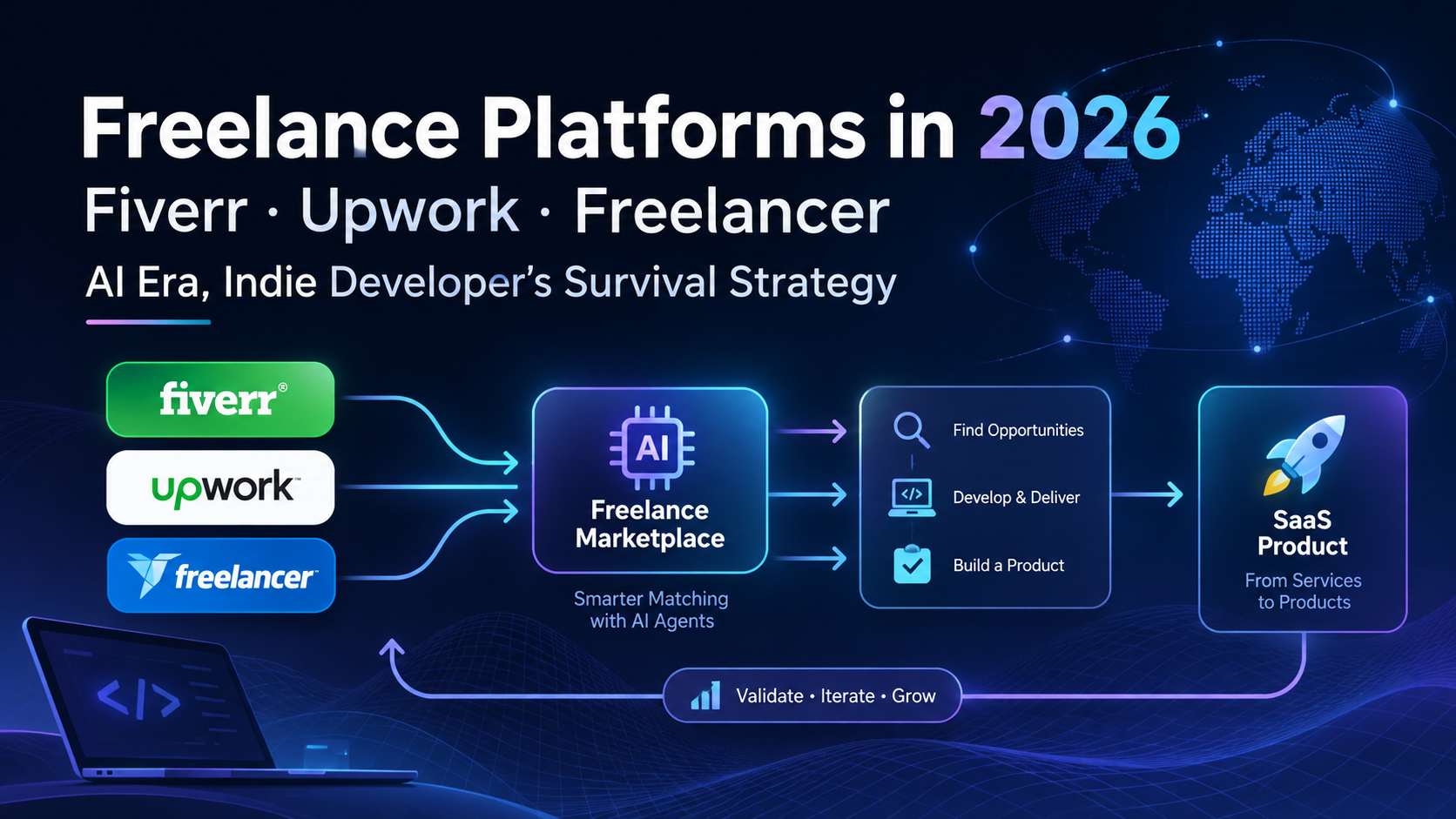
AI-powered development tools are fundamentally changing the economics of software engineering.
Tasks that once required a small development team can increasingly be handled by a single experienced developer working with tools such as Claude Code, GitHub Copilot, and other AI-assisted development environments.
But this creates an interesting question:
When the cost of building software keeps decreasing, where do developers find customers? And how do businesses find people who can turn AI-generated code into reliable software?
This is where freelance marketplaces such as Fiverr, Upwork, and Freelancer remain relevant.
These platforms are more than websites for finding freelance jobs. They are marketplaces that connect business demand, technical expertise, payment infrastructure, and professional services.
In this article, we’ll examine their business models, marketplace mechanisms, AI integration, and development workflows. More importantly, we’ll explore how independent developers can use these platforms to discover real business problems, generate revenue, and eventually build their own software products.
1. Understanding the Business Models of Three Major Freelance Platforms
Although Fiverr, Upwork, and Freelancer all connect businesses with independent professionals, their underlying marketplace models are quite different.
Understanding these differences is more useful than simply comparing platform popularity or transaction fees.
1.1 Fiverr: Service Productization
Fiverr uses a service-based marketplace model built around predefined offerings called Gigs.
Instead of applying for traditional job listings, freelancers package their skills into services that customers can browse and purchase.
For example, a developer might offer:
- Build a WordPress Website
- Develop a Chrome Extension
- Automate Python Scripts
- Integrate Third-Party REST APIs
- Build a Custom Web Scraper
From a software engineering perspective, this is essentially service productization.
A developer takes an otherwise uncertain development task and turns it into a clearly defined deliverable.
A typical service can be structured as follows:
| Component | Description |
|---|---|
| Input | Client requirements, design files, or existing source code |
| Process | Development, testing, debugging, and integration |
| Output | Source code, deployment files, and technical documentation |
| SLA | Delivery time, revision limits, and support terms |
| Pricing | Fixed packages based on scope and complexity |
For example, a Chrome Extension development service could offer three packages:
- Basic: A simple browser extension with one core feature.
- Standard: Additional configuration options, local storage, and a settings interface.
- Premium: API integrations, advanced business logic, and comprehensive testing.
The main advantage is that customers don’t have to evaluate an abstract amount of development time. They can purchase a relatively well-defined outcome.
Fee structure:
Fiverr freelancers generally receive 80% of the order value, meaning the platform retains 20% of seller earnings.
Source: Fiverr Help Center – Your Earnings.
1.2 Upwork: Project-Based Talent Matching
Upwork follows a different approach.
Clients publish job descriptions, and freelancers submit proposals explaining how they would solve the problem.
The client then evaluates candidates based on technical experience, portfolios, communication, pricing, and previous work.
A typical workflow looks like this:
Client Posts a Job
        |
        v
Requirement Analysis
        |
        v
Freelancers Submit Proposals
        |
        v
Client Reviews Candidates
        |
        v
Interview & Negotiation
        |
        v
Contract Creation
        |
        v
Development & Delivery
        |
        v
Payment
This model is particularly suitable for projects involving uncertain requirements or more complex engineering work.
Examples include:
- Designing and implementing a distributed system.
- Building a custom SaaS platform.
- Integrating multiple third-party APIs.
- Optimizing an existing backend architecture.
- Migrating legacy applications to modern infrastructure.
Compared with Fiverr, Upwork places greater emphasis on a freelancer’s technical background, problem-solving ability, and professional reputation.
Fee structure:
Upwork currently applies a variable Freelancer Service Fee ranging from 0% to 15% per contract.
The exact percentage is displayed before the contract begins and becomes fixed once the contract starts.
Source: Upwork – Freelancer Service Fee.
1.3 Freelancer: Competitive Bidding and Contests
Freelancer combines traditional project bidding with additional formats such as design and development contests.
Its typical project workflow looks like this:
Project Published
       |
       v
Freelancers Place Bids
       |
       v
Client Compares Proposals
       |
       v
Project Awarded
       |
       v
Milestone Payment
       |
       v
Delivery & Acceptance
The platform supports fixed-price projects, hourly contracts, and contests.
For developers, competitive bidding means evaluating several factors before accepting a project:
- Does the proposed solution match the technical requirements?
- Is the quoted price competitive?
- Is the estimated development time realistic?
- Does the client’s budget cover ongoing maintenance?
- Is there potential for a longer-term working relationship?
Fee structure:
Freelancer generally charges:
- Fixed-price projects: 10% of the project value or $5, whichever is greater.
- Hourly projects: 10% of each payment received.
- Contests: 10% of the prize or $5, whichever is greater.
Additional conditions may apply to specific membership levels and programs.
Source: Freelancer – Fees and Charges.
1.4 Comparing the Three Platforms
| Dimension | Fiverr | Upwork | Freelancer |
|---|---|---|---|
| Core model | Service marketplace | Project marketplace | Competitive bidding |
| How clients start | Purchase a Gig | Publish a Job | Publish a Project |
| Freelancer acquisition | Service listings | Proposals | Bids |
| Best suited for | Standardized services | Complex projects | Budget-defined projects |
| Main competitive advantage | Service packaging | Technical expertise and trust | Pricing and bidding |
| Standard freelancer fee | 20% | 0%–15% | 10% or $5 minimum |
Platform commissions are only one part of the overall cost.
Freelancers should also consider proposal preparation, customer communication, payment processing, taxes, and post-delivery support.
For independent developers, the most important metrics are not simply contract values, but net earnings and effective hourly rates.
2. How AI Is Changing the Architecture of Freelance Marketplaces
The traditional value proposition of a freelance marketplace is straightforward: connect customers with professionals.
However, generative AI and AI agents are changing how this connection happens.
A traditional marketplace workflow looks like this:
Client
  |
  v
Marketplace
  |
  v
Freelancer
  |
  v
Software Delivery
An AI-assisted workflow increasingly looks like this:
Client
  |
  v
AI Assistant / Agent
  |
  v
Marketplace
  |
  v
Expert Matching
  |
  v
Human + AI Development
  |
  v
Software Delivery
This is more than adding a chatbot to an existing platform.
The entire process of discovering opportunities, matching talent, and coordinating work is beginning to evolve.
2.1 AI Agents Are Entering the Hiring Process
Upwork is an interesting example of this transition.
Its AI assistant, Uma, supports workflows around job creation, candidate evaluation, and hiring.
In August 2026, Upwork introduced its official Model Context Protocol (MCP) Server.
MCP, or Model Context Protocol, provides a standardized way for AI applications to interact with external tools and services.
Instead of navigating a marketplace manually, users can increasingly interact with marketplace functionality through compatible AI applications.
Imagine a founder working on a software project:
I need someone to review my backend architecture.

Find experienced Python developers
with FastAPI and PostgreSQL experience.

Compare their profiles and prepare
a shortlist of suitable candidates.
Through an authorized MCP connection, an AI agent can interact with Upwork to help create job posts, search for qualified professionals, and prepare hiring workflows.
The important architectural change is that the marketplace becomes accessible from the AI environment where work is already happening.
On November 2, 2026, Upwork also announced the public beta of Upwork Now.
The feature allows clients to find freelancers who are online and ready to start working, while freelancers can signal their immediate availability.
Upwork Now can also work through its MCP integration, bringing on-demand human expertise directly into AI-assisted workflows.
These developments suggest that freelance marketplaces are evolving from traditional job-listing websites into more accessible talent infrastructure.
Official announcements:
2.2 AI Reduces Development Costs, Not Engineering Complexity
AI coding tools can generate code, write tests, explain errors, and assist with refactoring.
However, software engineering involves much more than generating source code.
A complete software delivery process still includes:
- Requirement Analysis.
- System Design.
- Data Modeling.
- API Design.
- Implementation.
- Automated Testing.
- Deployment and Monitoring.
- Security and Maintenance.
AI can accelerate many of these activities, but it cannot automatically guarantee that the resulting system satisfies business requirements.
Consider a simple FastAPI endpoint:
from fastapi import FastAPI

app = FastAPI()


@app.get("/api/users/{user_id}")
async def get_user(user_id: int):
    return {
        "user_id": user_id,
        "status": "active"
    }
Generating this endpoint is relatively easy.
However, it is far from production-ready.
A real application may also require:
- Authentication and authorization.
- Database integration.
- Input validation.
- Exception handling.
- Rate limiting.
- Structured logging.
- Unit and integration tests.
- Monitoring and observability.
The real value of an AI-assisted developer is therefore not simply the ability to generate code quickly.
It is the ability to integrate AI-generated output into a reliable, maintainable software system.
3. Building an AI-Assisted Development Workflow
For independent developers, one of the most effective approaches is to treat AI as part of a reusable engineering workflow rather than just a code-generation tool.
Let’s use a Python backend project as an example.
3.1 Establish a Reusable Technology Stack
Suppose a client needs a small SaaS backend.
A practical technology stack could look like this:
| Layer | Technology | Responsibility |
|---|---|---|
| Backend | FastAPI | API services |
| Database | PostgreSQL | Relational data storage |
| ORM | SQLAlchemy | Database access |
| Validation | Pydantic | Data validation |
| Cache | Redis | Caching and task coordination |
| Testing | Pytest | Automated testing |
| Containerization | Docker | Environment consistency |
| CI/CD | GitHub Actions | Automated build and testing |
| AI Coding | Claude Code / Copilot | Development assistance |
The objective is not to use as many technologies as possible.
The objective is to make different projects share the same engineering foundation.
For example, the following modules can be reused across multiple projects:
backend-template/
│
├── app/
│   ├── api/
│   │   ├── routes/
│   │   └── dependencies.py
│   │
│   ├── core/
│   │   ├── config.py
│   │   ├── security.py
│   │   └── logging.py
│   │
│   ├── models/
│   │
│   ├── schemas/
│   │
│   ├── services/
│   │
│   └── main.py
│
├── tests/
│
├── migrations/
│
├── Dockerfile
├── docker-compose.yml
├── pyproject.toml
└── README.md
When working on another similar project, there is no need to configure database connections, logging, testing frameworks, and containers from scratch.
You are effectively building your own reusable development infrastructure.
3.2 Use AI to Automate Development Tasks
A useful approach is to divide AI-assisted development into several stages.
Stage A: Requirement Analysis
Ask an AI assistant to transform client requirements into:
- Functional Requirements.
- Non-functional Requirements.
- API Specifications.
- Database Schemas.
- Potential Technical Risks.
Stage B: System Design
Use the requirements to produce an initial technical design:
Requirement
    |
    v
Architecture Design
    |
    v
Database Schema
    |
    v
API Specification
    |
    v
Implementation Plan
Stage C: Implementation
Instead of asking AI to generate an entire application in one step, break the work into smaller tasks.
For example:
Task 1: Implement database models.

Task 2: Implement authentication.

Task 3: Implement CRUD APIs.

Task 4: Add input validation.

Task 5: Write unit tests.

Task 6: Generate API documentation.
Each stage should be reviewed before moving forward.
This reduces the risk of incorrect assumptions spreading across multiple modules.
Stage D: Automated Validation
GitHub Actions can provide a basic continuous integration workflow:
name: Backend CI

on:
  push:
    branches: [main]
  pull_request:
    branches: [main]

jobs:
  test:
    runs-on: ubuntu-latest

    steps:
      - name: Checkout
        uses: actions/checkout@v4

      - name: Setup Python
        uses: actions/setup-python@v5
        with:
          python-version: "3.12"

      - name: Install dependencies
        run: |
          pip install uv
          uv sync --all-groups

      - name: Run tests
        run: |
          uv run pytest
Every code submission can now trigger an automated test run.
Passing automated tests does not guarantee that an application is defect-free. Payment processing, authorization, and sensitive data handling still require additional security reviews.
3.3 Standardize the Delivery Process
One of the biggest hidden costs of freelancing is not writing code.
It is repeated communication, project coordination, and documentation.
A standardized project structure can reduce this overhead:
project/
│
├── requirements/
│   └── specification.md
│
├── architecture/
│   └── technical-design.md
│
├── src/
│
├── tests/
│
├── docs/
│   ├── installation.md
│   ├── api-reference.md
│   └── deployment.md
│
└── delivery/
    └── handover.md
This approach provides three important benefits:
- Less repetitive work.
- Lower delivery risk.
- Better visibility for clients.
The key idea is to turn individual development skills into a reusable engineering system.
4. Finding SaaS Opportunities Through Freelance Projects
For Indie Hackers, freelance marketplaces provide another valuable resource:
They continuously expose developers to real business problems.
A traditional product development process often looks like this:
Idea
  |
  v
Market Research
  |
  v
MVP Development
  |
  v
Launch
  |
  v
User Acquisition
The problem is that developers may spend months building something before discovering whether the market actually needs it.
Observing freelance project requirements can provide earlier market signals.
4.1 Identify Repeated Problems
Imagine finding the following projects across different clients:
| Project Requirement | Potential Shared Problem |
|---|---|
| Automate Excel Reports | Repetitive data processing |
| Convert PDF to Images | Document conversion |
| Batch Resize Images | Image processing |
| Extract Data from Websites | Data collection |
| Generate API Documentation | Development automation |
If similar requirements appear repeatedly, they deserve further investigation.
However, repeated requests do not automatically mean there is a viable SaaS opportunity.
Some tasks are occasional custom work. Others represent recurring problems that can be solved with a standardized product.
To evaluate an opportunity, ask:
- Have multiple independent clients reported the same problem?
- Does the task have relatively stable inputs and outputs?
- Can a common technical solution handle most use cases?
- Are customers willing to pay for a reusable solution?
- Does the solution require significant ongoing human intervention?
4.2 Build a Simple Opportunity Scoring Model
A basic scoring model can help prioritize potential product ideas.
Define:
- F: Frequency of demand (1–5).
- R: Repeatability of the problem (1–5).
- W: Automation feasibility (1–5).
- P: Customer willingness to pay (1–5).
- C: Development complexity (1–5).
The formula is:
[ Score = \frac{F \times R \times W \times P}{C} ]
For example:
| Metric | Score |
|---|---|
| Demand Frequency (F) | 4 |
| Repeatability (R) | 5 |
| Automation Feasibility (W) | 5 |
| Willingness to Pay (P) | 4 |
| Development Complexity (C) | 2 |
The result is:
[ Score = \frac{4 \times 5 \times 5 \times 4}{2}=200 ]
This is not a statistically validated market prediction model.
It is simply a lightweight heuristic for comparing opportunities and deciding which ideas deserve further investigation.
Actual product validation still requires customer interviews, willingness-to-pay experiments, and retention data.
4.3 From Custom Development to Recurring Products
Consider a client requesting a batch image processing tool.
The original requirement might look like this:
Client Requirement:

I need a tool to resize hundreds of images
and generate different image formats.
You initially solve the problem through custom development.
But during the process, you discover several recurring requirements:
- Different customers need batch image resizing.
- Image format conversion is a frequent task.
- Users want to generate Chrome Extension icons.
- Some users prefer not to upload images to third-party servers.
This may indicate an opportunity for productization.
The evolution could look like this:
Custom Development
        |
        v
Reusable Image Processing Module
        |
        v
Standalone Desktop / Browser Tool
        |
        v
Product MVP
        |
        v
Independent SaaS / Utility Product
This is the transition from one-time service revenue to product revenue.
Not every freelance project should become a SaaS product. Highly customized, infrequent, or human-intensive tasks may remain more profitable as professional services.
The important thing is to recognize when a reusable solution makes economic sense.
5. Calculating the Real Economics of Freelance Development
Many developers evaluate freelance projects based only on contract value.
However, the actual economics are more complicated.
Consider a project worth $1,000.
| Cost Item | Amount |
|---|---|
| Contract Value | $1,000 |
| Platform Fee (Assumed 10%) | -$100 |
| AI Tool Costs | -$20 |
| Other Project Costs | -$30 |
| Net Project Revenue | $850 |
Now consider the time required:
- Requirement communication: 3 hours.
- Technical design: 4 hours.
- Development: 15 hours.
- Testing: 4 hours.
- Deployment and delivery: 4 hours.
- Post-delivery support: 2 hours.
Total time: 32 hours.
The effective hourly rate is:
[ Hourly\ Rate = \frac{850}{32} ]
[ Hourly\ Rate \approx $26.56 ]
This calculation still excludes taxes and any additional business expenses.
Looking only at the $1,000 contract value would give an incomplete picture.
From a business perspective, the more useful metrics are net revenue, time investment, and opportunity cost.
Before accepting a project, consider following a simple evaluation process:
Project Evaluation
        |
        v
Estimate Development Hours
        |
        v
Estimate Platform Fees
        |
        v
Estimate AI & Infrastructure Costs
        |
        v
Calculate Net Revenue
        |
        v
Evaluate Maintenance Risk
        |
        v
Accept / Reject
For independent developers, knowing when to reject a low-value project is just as important as knowing how to win one.
6. Which Technical Skills Matter More in the AI Era?
If AI can generate large amounts of code quickly, competing purely on coding speed may become increasingly difficult.
But the value of software engineering has never been limited to writing code.
I believe independent developers should focus on several important areas.
6.1 System Architecture and Engineering
Important skills include:
- Backend Architecture.
- Database Design.
- Distributed Systems.
- API Design.
- Security Engineering.
- Performance Optimization.
AI can generate implementation code, but complex systems still require human judgment around architecture, trade-offs, and long-term maintainability.
6.2 Automation and Integration
Businesses rarely suffer from a lack of individual software tools.
More often, their problem is that different tools cannot communicate effectively.
For example:
CRM
 |
 v
API Integration
 |
 v
Data Processing
 |
 v
Automation Workflow
 |
 v
Reporting System
Developers who can connect systems, process data, and automate business workflows provide clear commercial value.
6.3 AI Agents and MCP Integration
AI agents can do more than generate text.
They can interact with external tools and perform actual tasks.
Examples include:
- Querying databases.
- Accessing third-party APIs.
- Executing automation workflows.
- Inspecting code repositories.
- Creating and managing tasks.
Protocols such as MCP provide a standardized integration layer between AI applications and external services.
This creates new opportunities for independent developers to build tools and services that can be called directly by AI agents.
6.4 Product Thinking and Customer Understanding
This is one of the most frequently overlooked skills among technically focused developers.
Just because a feature can be implemented does not mean it deserves to exist.
Developers need to understand:
- What problem is the customer actually trying to solve?
- Why are existing solutions insufficient?
- What are users willing to pay for?
- Will the product be used repeatedly?
- Is the customer acquisition cost sustainable?
Technical ability answers the question of how.
Product thinking answers the question of why.
Combining both is what creates long-term competitive advantages.
7. Conclusion: From Selling Development Hours to Building Technical Assets
The freelance ecosystem is changing in 2026.
Fiverr, Upwork, and Freelancer continue to provide different ways to connect customers with professionals, manage transactions, and deliver projects.
However, AI is changing how these platforms connect demand with talent.
For independent developers, I believe a sustainable strategy can be divided into three stages.
Stage 1: Generate Cash Flow Through Services
Use existing technical skills to take on small development projects.
Build experience, understand customer requirements, and develop a better understanding of real market demand.
Stage 2: Improve Delivery Efficiency Through Automation
Use AI coding tools, standardized project templates, CI/CD pipelines, and reusable modules to reduce repetitive development work.
Stage 3: Build Long-Term Assets Through Productization
Identify recurring problems from real projects and turn reusable solutions into Chrome extensions, developer tools, desktop applications, or SaaS products.
These stages are not mutually exclusive.
You can continue providing professional services while building your own products. You can also use product development experience to improve the quality of your freelance work.
For an independent developer, the most important objective is not to master every new AI tool.
It is to build a sustainable system for continuously creating value.
AI can reduce the cost of software development, but it cannot automatically guarantee product success.
Understanding customer needs, engineering reliable solutions, delivering a good user experience, and reaching the right audience remain essential.
Writing code is only one part of the process.
Finding problems, solving them, and making sure the people who need your solutions can discover them — that is the complete indie development journey.
References
- Fiverr Help Center – Your Earnings
- Upwork – Freelancer Service Fee
- Upwork – Freelancer Pricing
- Freelancer – Fees and Charges
- Upwork – Uma AI
- Upwork – MCP Server Announcement, August 2026
- Upwork – Upwork Now Announcement, November 2026
Note: Platform features, service fees, and availability are based on official information accessible as of November 4, 2026. Actual fees and feature availability may vary depending on location, account type, membership, and contract terms.